| Characteristics | Real Human ME Datasets | MiE-X Dataset | EquiME (Ours) |
|---|---|---|---|
| Data Format | Video Sequences (Spontaneous or Elicited) |
Static Images (Apex & Onset frames) |
Video Sequences (Temporal Data) |
| Dataset Scale | |||
| Subjects | 20-40 | 5,000 | 15,000 |
| Samples | 100-300 | 45,000 | 75,000 (15,000 × 5 class) |
| Emotion Classes | 3-7 Classes (Often imbalanced) |
3 Classes | 5 Classes |
|
• Happiness • Sadness • Surprise • Disgust • Anger • Fear • Contempt (some datasets) |
• Positive • Negative • Surprise |
• Happiness • Sadness • Surprise • Disgust • Anger |
|
| Technical Specifications | |||
| Resolution | Varies (often 640×480 or higher) | 128 x 128 pixels | 256 × 256 pixels |
| Customization | No | No | Yes |
| Data Collection | Lab environment (Controlled conditions) |
Synthetic | Synthetic |
| Note: EquiME offers comprehensive temporal information similar to real datasets but with much larger scale and balanced emotion distribution | |||
Abstract
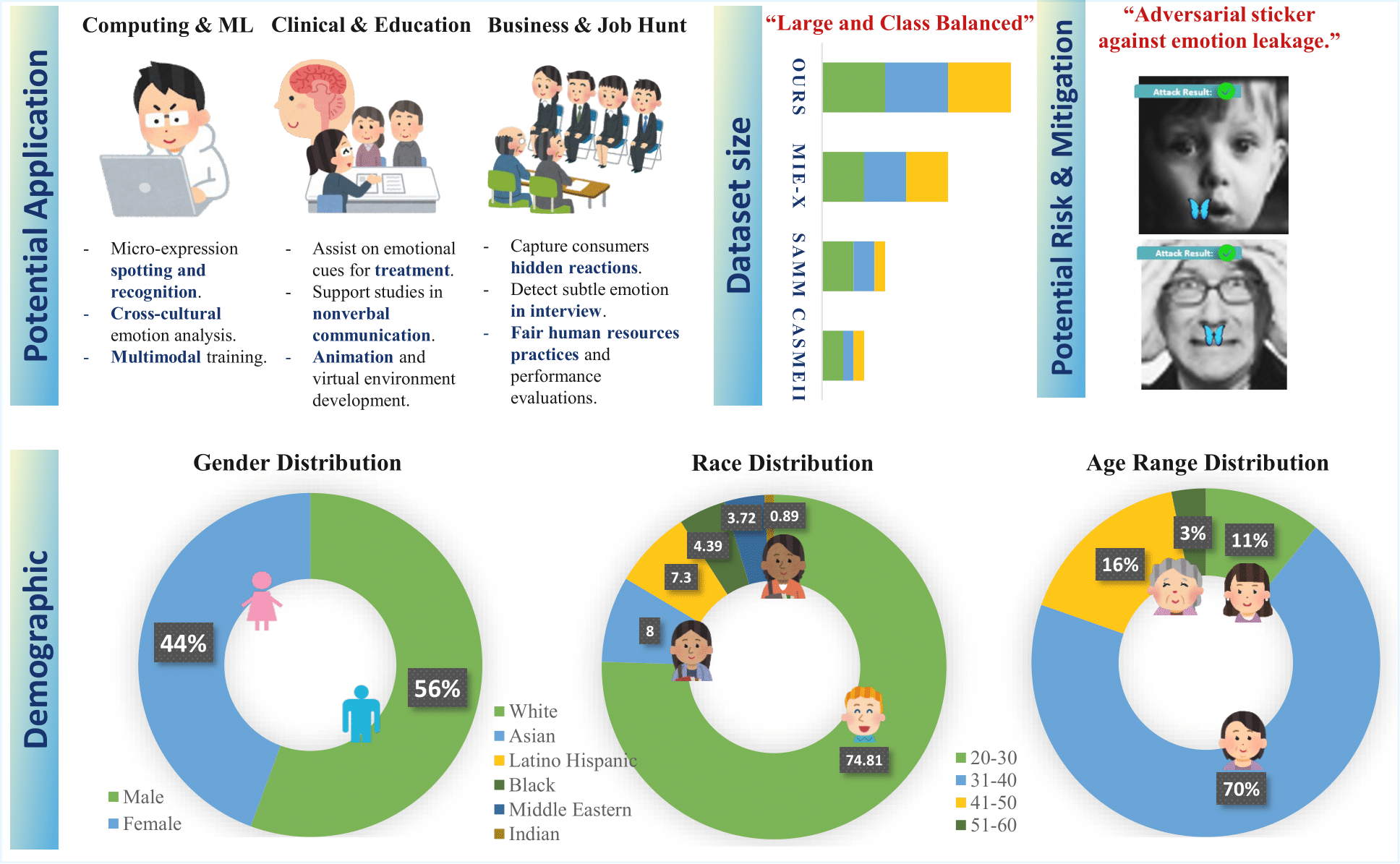
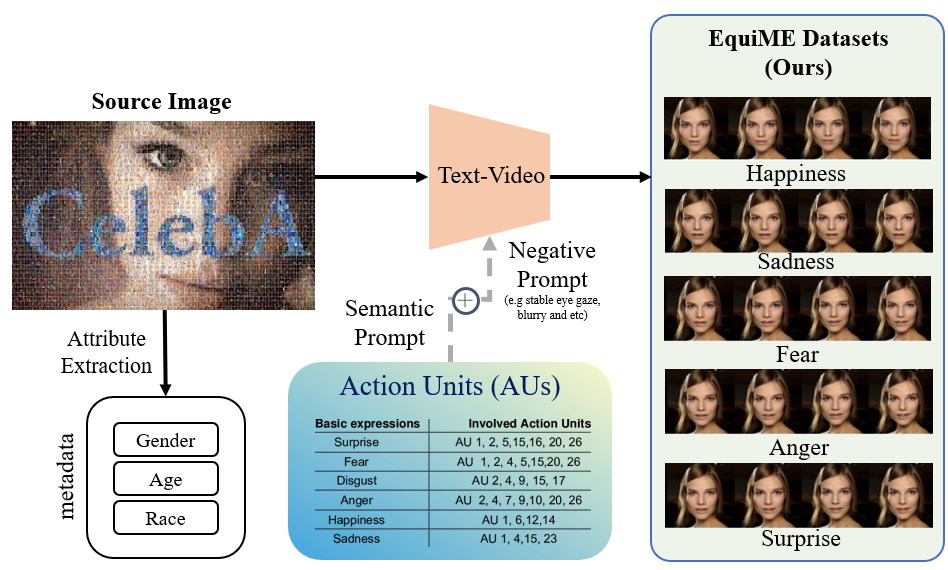
Micro-expression (ME) recognition is a challenging task due to the subtle and transient nature of these facial movements. Existing real-world ME datasets are limited in scale, diversity, and emotional breadth, hindering the development of robust recognition models. In this work, we introduce EquiME, a large-scale synthetic dataset for micro-expression analysis, generated using the image-to-video model. By leveraging a structured causal modeling approach, we employ Facial Action Units (AUs) as intermediate representations that drive the generation of realistic ME sequences. Our dataset achieves significant demographic diversity (55.6% women, 44.4% men; representation across six racial groups) while simultaneously capturing five distinct emotion categories—a balance rarely achieved in real-world data collection where recruiting diverse participants capable of expressing all target emotions remains challenging. Experimental results show that training on EquiME, followed by cross-validation evaluation, it shows consistency of performance across different model architectures. This paper presents a streamlined pipeline for generating synthetic micro-expression datasets, designed to be accessible to users without a computer science background.